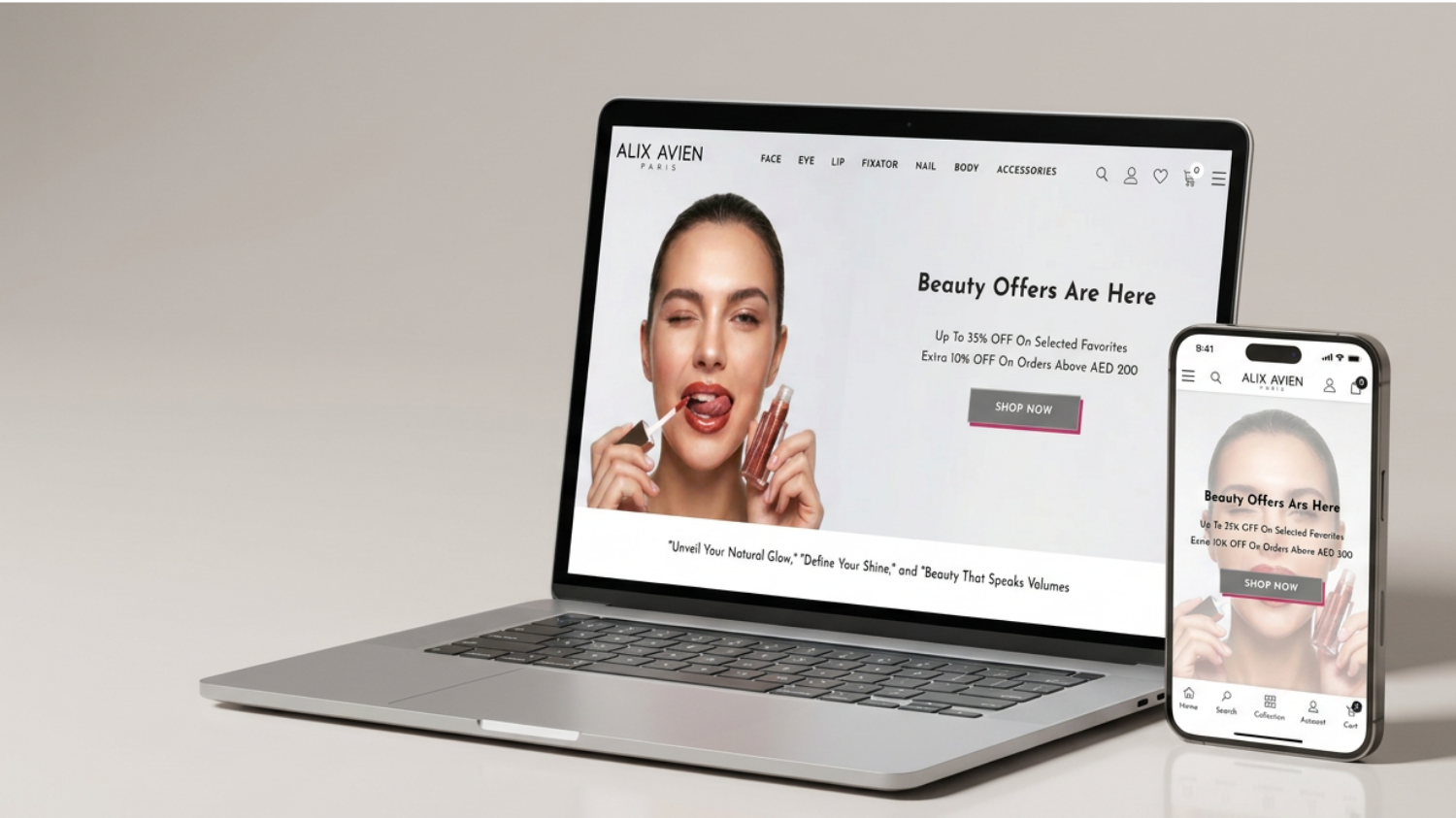
High-converting Shopify store for a lifestyle brand
In short: Loop2Tech built a Shopify storefront for a lifestyle brand launching direct to consumer. The work covered three areas that decide whether a new store survives its first quarter: a theme rebuilt around performance rather than effects, collection pages structured to earn organic traffic, and a checkout stripped of the friction that drives the industry's cart abandonment rate.
What a launching brand actually needs
A new store has no traffic history, no conversion baseline, and no domain authority. That changes what is worth doing in month one. There is no data to optimise against, so the only real levers are architectural.
The brief here was familiar: a beautiful storefront that converts. The honest version of that brief is narrower. A launching brand needs a store fast enough to hold mobile traffic, a category structure search engines can read, and a checkout that does not lose people who already decided to buy.
The Baymard Institute has tracked a global average cart abandonment rate above 70% across fourteen years of research. For an established retailer that is a percentage point of optimisation. For a launch, it is the difference between a viable quarter and a dead one.
Rebuilding the theme around performance
The starting point was a premium theme carrying a full set of animation libraries, a slider, three icon fonts, and several apps installed during evaluation and never removed. Each addition looked harmless. Together they had pushed the storefront well past the point where mobile shoppers wait.
We rebuilt rather than tuned. The sequence matters, so it is worth stating in order.
- Audit every script. List what loads, what it does, and who asked for it. Most stores are carrying at least two scripts nobody can account for.
- Remove uninstalled app residue. Shopify apps frequently leave theme code behind after removal, and that code still loads and still costs.
- Replace the slider with a static hero. Sliders carry a large JavaScript cost, and the second slide is seen by a small fraction of visitors.
- Serve the hero image correctly. Correct format, correct dimensions, preloaded, never lazy loaded. The hero is almost always the Largest Contentful Paint element.
- Subset the fonts. Three icon fonts became one small icon set. Display fonts were reduced to the weights actually used.
- Defer everything non-critical. Reviews widgets, chat, and analytics load after the page is interactive rather than blocking it.
Largest Contentful Paint is the time until the largest visible element finishes rendering, and Google's threshold is 2.5 seconds. On a launching store this is not a technical nicety. It is the first impression, and on mobile connections it is often the only one you get. The detailed method is in our Shopify speed optimisation guide.
Collection pages built to earn traffic
Collection pages are the highest-value organic real estate a store owns and the most consistently neglected. They match commercial intent directly, and most stores ship them as a product grid with a two-word heading.
We treated each collection as a landing page. Every one opens with content that genuinely answers the category question, carries breadcrumb markup, and exposes filters as crawlable URLs rather than JavaScript state. The full method is documented in our guide to collection page SEO.
The filter decision most stores get wrong
Faceted navigation can generate thousands of URL combinations, and left unmanaged it burns crawl budget (the number of pages a search engine will fetch from your site in a given period) on combinations nobody searches for.
We opened the filter combinations with real search demand behind them and closed the rest. Colour and category combinations that people actually search for are indexable landing pages. Arbitrary multi-filter permutations are not. Getting this backwards is the most common technical failure we find in store audits, and it is invisible until months of crawl data accumulate.
Removing friction from the checkout path
Most abandonment causes are known, documented, and fixable. They are also boring, which is why they survive.
| Abandonment trigger | What we changed |
|---|---|
| Shipping cost revealed at checkout | Stated on the product page and in the cart drawer |
| Forced account creation | Guest checkout as the default path |
| Delivery timing unclear | Estimated dates shown before payment |
| Return policy hidden in the footer | Summarised in the cart, linked in full |
| Payment options unclear | Accepted methods shown at cart, not discovered at payment |
None of these is a design innovation. All of them address a documented reason people leave. On a launching store with no conversion data to test against, applying the known fixes beats running experiments you have no traffic to power.
What we deliberately did not do at launch
We did not install a review widget, a loyalty app, a popup suite, or a personalisation engine. A store with no orders has no reviews to display and no behaviour to personalise. Every one of those tools adds weight immediately and delivers value only later.
This is a position we hold and clients sometimes push back on. Install them when there is something for them to do. Our Shopify launch guide sets out the full sequence.
Who this build suits
This engagement shape fits brands going direct to consumer for the first time, brands migrating off a marketplace onto their own storefront, and existing stores where a theme has accumulated years of app residue and needs rebuilding rather than tuning.
If any of those describe you, our Shopify development service covers the build, and our AEO, GEO and SEO services cover the search architecture that has to be decided before launch rather than after. Tell us where you are in the launch and we will tell you what to do first.
Frequently asked questions
What makes a Shopify store convert well?
A high-converting Shopify store loads fast on mobile, states shipping cost and delivery timing before the checkout step, allows guest checkout, and makes the return policy visible in the cart. Loop2Tech applies these known fixes at launch rather than testing them, because a new store has no traffic volume to power a meaningful experiment. Conversion testing becomes useful once there is order data to test against.
How do you speed up a slow Shopify theme?
Start by auditing every script that loads and removing residue left behind by uninstalled apps, which frequently persists in theme code after removal. Then replace sliders with static heroes, preload the hero image rather than lazy loading it, subset fonts to the weights actually used, and defer reviews, chat and analytics until after the page is interactive. Loop2Tech follows this order because the early steps often remove the need for the later ones.
Why are collection pages important for e-commerce SEO?
Collection pages match commercial search intent directly, which makes them the highest-value organic pages an online store owns. Most stores ship them as a bare product grid with a two-word heading, which gives search engines nothing to rank. Treating each collection as a landing page with genuine introductory content, breadcrumb markup and crawlable filter URLs is the single largest organic opportunity in most catalogues.
Should a new store install review and loyalty apps at launch?
No. A store with no orders has no reviews to display and no customer behaviour to personalise, so review widgets, loyalty apps and personalisation engines add page weight immediately while delivering value only later. Loop2Tech recommends launching without them and installing each one at the point where it has something to do.
How long does a Shopify build take?
A Shopify storefront with a custom theme build, structured collection architecture and a full pre-launch technical pass typically runs six to ten weeks, depending on catalogue size and how much product content needs writing. Loop2Tech runs these with a staging link open throughout, so the client reviews real pages with real products rather than waiting for a final reveal.
-
Expertise
- Shopify
- E-commerce
- CRO
- SEO
-
Client
Confidential (lifestyle and apparel)
-
Date
02 August, 2026
More Work