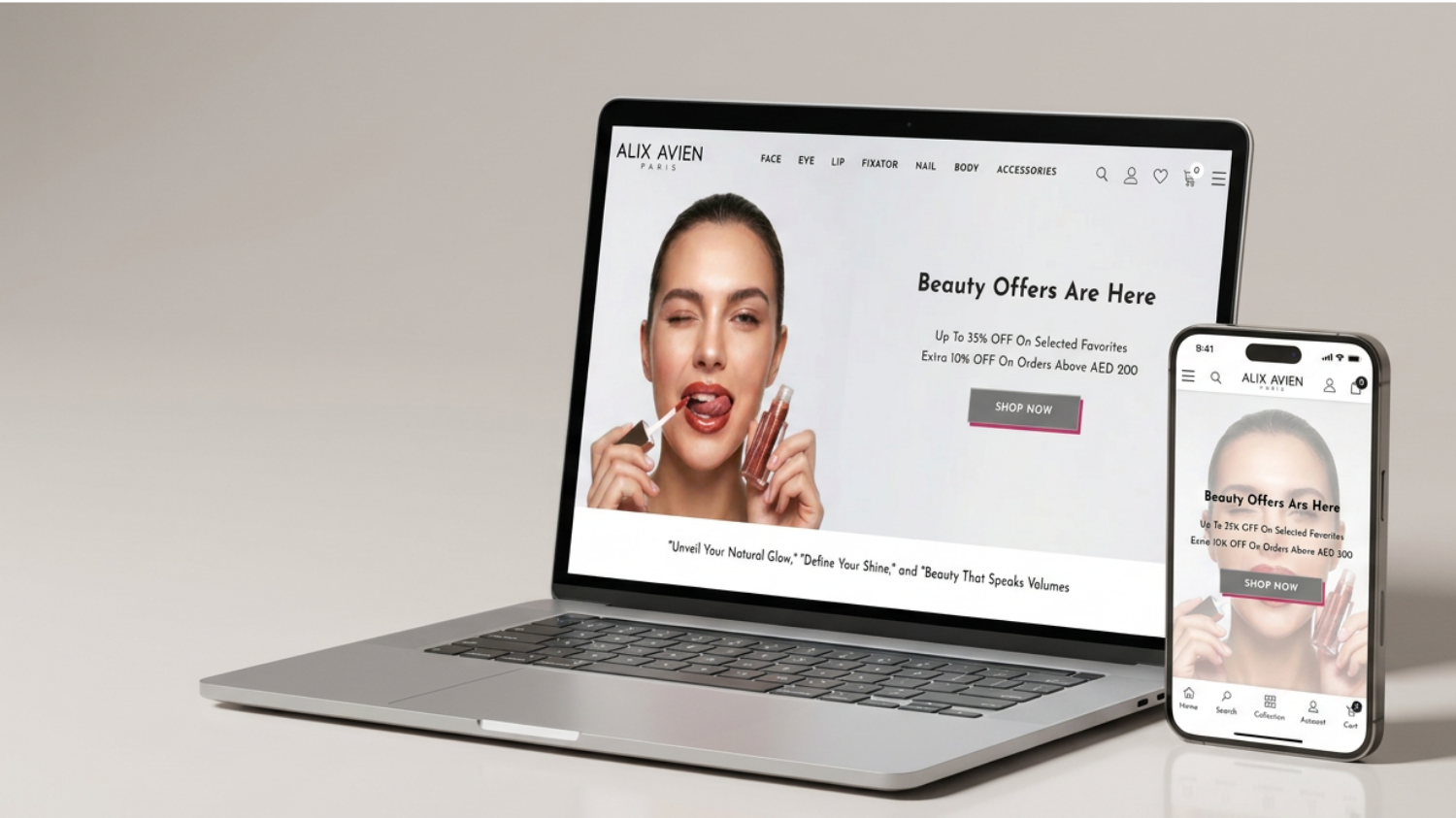
Alix Avien AE: e-commerce build for a growing makeup brand
In short: Loop2Tech built the e-commerce presence for Alix Avien in the UAE market, a cosmetics brand where a single product can carry twenty or more shades. The build solved shade-level variant architecture without fragmenting search authority, structured ingredient and usage content so it can be quoted by AI answer engines, and shipped a catalogue that stays fast as it grows.
What makes a cosmetics catalogue harder than it looks
A makeup catalogue breaks the assumptions most e-commerce templates are built on. One lipstick is not one product, it is one product with twenty-four shades, each with its own image, its own stock level, and its own set of people searching for it by name.
Handle that badly and you get one of two failures. Either every shade becomes its own page, which splits authority across two dozen near-identical URLs and buries all of them, or shades exist only as JavaScript state, which means no shade is findable in search at all.
Beauty buyers also research before they buy. They search for ingredients, for skin-type suitability, for whether a formula is suitable under a certain condition. A product page carrying only a name, a price, and three marketing adjectives answers none of that, and in an AI-mediated search environment it gives the engine nothing to quote.
How we structured shades and variants
We used a single canonical product page per product with shades as selectable variants, each shade carrying its own image, stock state, and structured data entry. The product page is the authority-holding URL. Shades are addressable but do not compete with it.
| Approach | Search outcome | Customer outcome |
|---|---|---|
| One page per shade | Authority split across near-duplicate URLs | Shade switching means a full page reload |
| Shades as JavaScript only | No shade is findable in search | Fast switching, but no shareable link |
| Canonical product with addressable variants | Authority consolidated on one URL | Instant switching plus a shareable shade link |
The third row is what we shipped. A shopper can send a friend a link to a specific shade, the URL resolves with that shade preselected, and search engines still treat the parent product as the single canonical page.
Structured data at the variant level
Product variant markup tells search engines that several purchasable options belong to one product rather than being separate products. Google documents this alongside its merchant listing requirements, and it is the difference between a catalogue that is eligible for shopping surfaces and one that is not.
Every product on this build carries product markup with an offer node per shade, availability, price, and brand. Getting this right is the highest-leverage technical work available to any cosmetics retailer, and it is routinely missing. Our guide to schema types that actually matter covers what to implement and what to skip.
Writing product content that AI engines can quote
Generative engines cite passages that make specific, self-contained, checkable claims. A product description reading "luxurious, long-lasting colour" gives an engine nothing. A description stating the formula's finish, wear duration, key ingredients, and suitability answers a real question and can be lifted verbatim into an answer.
We restructured the product content template so every product carries four blocks: what it is, what is in it, who it suits, and how to use it. That structure exists because those are the four things people actually ask an assistant before buying makeup.
The same principle drives the category pages. A collection page that lists products and nothing else is a dead end for search. One that opens with a genuine answer to the category question earns the position. We set out the full method in our guide to collection page SEO, and the underlying content principle in writing answer-first content for AI engines.
The regional detail that changed the build
Selling cosmetics into the UAE is not the same as selling into Pakistan or Europe. Shoppers switch between English and Arabic search, currency and delivery expectations differ from the market the brand originated in, and ingredient questions carry specific regional weight.
We built the content architecture to carry those differences rather than translating a single market's copy. This is the kind of requirement that never appears in an initial brief and always appears in the first month of real traffic.
Performance across a growing catalogue
A cosmetics catalogue is image-heavy by nature. Every shade needs a swatch and a product shot, which means the number of images grows far faster than the number of products.
We handled this at the upload pipeline rather than through staff discipline: derivatives are generated automatically, images are served as WebP with explicit dimensions, and below-the-fold images are lazy loaded. Explicit dimensions matter more here than anywhere, because a grid of thirty swatches without them produces layout shift on every page load.
Core Web Vitals are the metrics Google measures for loading and interactivity: Largest Contentful Paint under 2.5 seconds, Interaction to Next Paint under 200 milliseconds, and Cumulative Layout Shift under 0.1. On an image-dense catalogue these are build requirements, not post-launch fixes. The specific techniques are in our store speed optimisation guide.
What this build applies to
Any retailer with high variant counts faces the same three problems this project solved: variant architecture that does not fragment authority, product content substantial enough to be quoted, and image handling that survives catalogue growth. Cosmetics, apparel, footwear, and paint all share the shape.
If you are launching or rebuilding a catalogue with this profile, our Shopify development service and our AEO, GEO and SEO services are usually run together rather than in sequence, because retrofitting search structure into a live catalogue costs more than building it in. Send us your catalogue size and variant structure and we will tell you what the architecture should be.
Frequently asked questions
How should an e-commerce store handle product variants for SEO?
Keep one canonical product page as the authority-holding URL and make variants addressable within it rather than giving each variant its own competing page. On the Alix Avien AE build, Loop2Tech gave every shade its own image, stock state, and offer node in the structured data while consolidating search authority on the parent product URL. Splitting a twenty-four shade lipstick into twenty-four pages divides authority across near-duplicate content and buries all of them.
What should a cosmetics product description include?
A cosmetics product description should cover four things: what the product is, what is in it, who it suits, and how to use it. Generative engines such as ChatGPT, Perplexity and Google AI Overviews cite passages that make specific, self-contained claims, so a description listing finish, wear duration, key ingredients and suitability can be quoted directly while marketing adjectives cannot.
Why do beauty stores load slowly?
Beauty stores load slowly because image count grows faster than product count: every shade needs a swatch and a product shot, so a hundred-product catalogue can carry over a thousand images. The fix is to move resizing and WebP conversion into the upload pipeline so the storefront never serves a raw phone photo, and to set explicit image dimensions so a grid of swatches does not cause layout shift.
Does Loop2Tech work with brands outside Pakistan?
Yes. Loop2Tech is based in Karachi, Pakistan and delivers projects for clients across the Middle East, Europe, North America and Australia, including this build for the UAE market. Selling into a different market changes the content architecture rather than just the translation, because search behaviour, currency expectations and product questions differ by region.
Should search work start before or after an e-commerce launch?
Search work should start before launch, during the architecture phase. Variant structure, category URLs, structured data and image handling are all architectural decisions, and changing them on a live catalogue means URL migrations, redirects and a recovery period. Loop2Tech runs e-commerce development and search work as one engagement for this reason.
-
Expertise
- E-commerce
- Beauty
- Web Development
- SEO
-
Client
Alix Avien (AE)
-
Date
02 August, 2026
More Work